AR drill/mill fixtures... have we been doing it wrong for years???

Well something to keep in mind.... I made my own side plates and a grip block like you did... got 3 RTB AR15 blanks and that other ar10 replacement to do... as I don't have any stripped lowers laying around I used an ar10 lower from another supplier out of oregon to mark where to drill the grip screw hole.. just dropped a layout punch through the grip screw hole a light tap.. figured better to be sure dead on in right spot etc.. drilled it and used end mill to counter sink outside etc.... went to test it on onea the RTB AR15 lowers and... the hole is off.. by about a 1/16th or better..... tried to figure it out... then put the block on the RTB AR10 blank... lines up almost perfect grip boss is thicker on the RTBAR10 so gotta widen the slot a lil etc.. then put it on yet another AR10 lower this one from 5D and it lines up perfect! put it on the one from oregon and again lines up perfect... it seems that not every 80% company actually has the grip screw in a universal location/angle still yet to be determined as have ALOT going on right now will try to get pics time permiting... just a heads up it might not be so universal... gonn slot the grip screw hole so can get it to work with the RTB AR15 lowers later

Slotting it probably isn't a bad idea, though at this point I wouldn't use the dimensions of any of RTB's lowers as a reference point. Look at it this way, If you have to move the grip screw hole in the jig to get it to work, then you will also have to move the hole in any grip you want to use on that lower too.

I've been able to check my little jig against a number of AR lowers at this point. A mix of commercial ones (Anderson, Compass Lake, and Rock River) as well as 80% ones from Brownells, Midway, and Tactical Machining. The only ones I have with issues are the two that came from Right To Bare.

So, from my point of view, I'm just going to assume that if the dimensions of a RTB lower doesn't fit the jig, it's the RTB lower that is wrong. That's just what my small sample size of lowers is showing me... whoever machined RTB's lowers can't read the long published blueprints for an AR. ;)
 
Last edited:
yea I needa pull a few apart and check it against them..... noticed they have the 308s back on the site so I guess whoever is doing their lowers got the detent hole corrected... just been so busy latelly haven't had alot of time to just put into the shop...
 
What the inside of the sides look like when done. There is an extra block that goes through the trigger guard, this is a leftover from a previous modification to the jig and really isn't needed anymore (I just haven't gone to the trouble of removing it.)

The only other modification I am considering is to drive the steel drill bushings out of one side, and install them in the other side. So you would drill the safety selector hole starting from the detent side. This might lead to a more accurate hole. I dunno, I'm still pondering this.

View attachment 15247

The spare A2 grip is just a little quick test tool. I ground down a 1/8" steel rod to a point and drove it into the detent spring hole. This can be put onto a lower to check that the detent hole in the lower is in the correct location prior to loading it into the jig for milling.

I just found out that the AR-10 lower I got from RightToBear.com (Daytona Beach) was incorrectly machined. I'm waiting to hear back from them if they will replace it. I just sent the photos they requested yesterday to illustrate what is wrong. (They machined it about 1/8th inch too far to the rear of the receiver so it doesn't line up with any grip.) We'll see how this goes. I've never had a receiver show up with the hole in the wrong place before, but I guess there is a first time for everything.

Checking a Tactical Machining lower shows the holes perfectly aligned (the steel pin in the grip goes right down the center of the detent hole in the lower.

View attachment 15248

Same test with the RightToBear lower shows the mistake in the milling... the holes don't line up and the detent spring would never work... it would end up crushed between the grip and the lower during assembly. Safety Selector wouldn't work right either, since the other end of the hole doesn't intersect a properly placed selector hole through the width of the lower.

View attachment 15249
Most excellent test tool! what a great idea! Need more time to read through this thread more carefully in the near future.
 
Just thinking through the problem of how to clamp onto an AR lower (any AR lower, be it AR-15, AR-10, LR308, etc.) and it sortta dawned on me that perhaps all the jigs are going about this the wrong way.

Before throwing stones and rotten tomatoes at me for my heresy, hear me out...

How do nearly all the milling fixtures work now? They wrap around the outside of the lower and key off the take-down pin holes in order to locate the point where the safety selector and hammer/trigger pins are drilled. So, the side plates of the fixture have to be relieved for the various ribs and details a manufacturer chooses to add on the outside of their AR lower. And, the jig has to account for the different dimensions of where the take-down pins are on an AR-15 vs. AR-10. Lastly, the jigs all have some form of top plate bolted on that keeps the jigs sides from folding in when you try to clamp it.

Turn the problem around and think about what all AR's have in common regardless of model.

Well, they all accept the same injection molded plastic grip. It is so common that nobody even thinks about whether manufacturer X's grip is going to fit. People just buy it and bolt it on. And that grip is always attached with same size bolt in the same place.

Also, the relationship between that grip mounting point and the fire control parts is the same on all AR designs, so the centers for all the holes (safety selector, trigger pin, hammer pin, and the happy pin we are not allowed to talk about) can all be located off the safety selector detent hole and grip mount.

So... why the heck are we not making our fixtures to attach to the grip mounting point and indexing off the safety selector detent hole? It is low on the receiver, so it fits well inside typical vise jaws. It is a very solid chunk of metal that will take a lot of clamping force. And it is hidden by the grip after assembly so if you accidentally mar the surface, nobody will ever know it.

This is something I'd like to explore in detail.

View attachment 15062
You make one and I would buy it! Seems like it would work well to me!
 
Just thinking through the problem of how to clamp onto an AR lower (any AR lower, be it AR-15, AR-10, LR308, etc.) and it sortta dawned on me that perhaps all the jigs are going about this the wrong way.

Before throwing stones and rotten tomatoes at me for my heresy, hear me out...

How do nearly all the milling fixtures work now? They wrap around the outside of the lower and key off the take-down pin holes in order to locate the point where the safety selector and hammer/trigger pins are drilled. So, the side plates of the fixture have to be relieved for the various ribs and details a manufacturer chooses to add on the outside of their AR lower. And, the jig has to account for the different dimensions of where the take-down pins are on an AR-15 vs. AR-10. Lastly, the jigs all have some form of top plate bolted on that keeps the jigs sides from folding in when you try to clamp it.

Turn the problem around and think about what all AR's have in common regardless of model.

Well, they all accept the same injection molded plastic grip. It is so common that nobody even thinks about whether manufacturer X's grip is going to fit. People just buy it and bolt it on. And that grip is always attached with same size bolt in the same place.

Also, the relationship between that grip mounting point and the fire control parts is the same on all AR designs, so the centers for all the holes (safety selector, trigger pin, hammer pin, and the happy pin we are not allowed to talk about) can all be located off the safety selector detent hole and grip mount.

So... why the heck are we not making our fixtures to attach to the grip mounting point and indexing off the safety selector detent hole? It is low on the receiver, so it fits well inside typical vise jaws. It is a very solid chunk of metal that will take a lot of clamping force. And it is hidden by the grip after assembly so if you accidentally mar the surface, nobody will ever know it.

This is something I'd like to explore in detail.

View attachment 15062
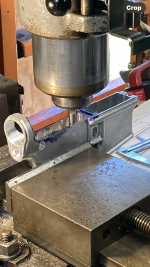
I just do this….
 

Attachments

  • IMG_2023.png
    IMG_2023.png
    3.9 MB · Views: 95
Last edited:
I just do this….

Yeah, that works too. I just don't like running the risk of the vise jaws marring the visible surface of the lower. I went with the block so the clamping is all done on a part of the lower that is hidden when assembled.
 
Back
Top