Polymer80 AR Lower Milling

JeffTech 124

New member
Joined
Jul 5, 2022
Messages
3
Reaction score
0
Points
1
Has anybody been able to mill a lower AR P80 lower frame using a Dremel drill press workstation?

 
I don't have any experience with the P80 AR frame. But someone here does, I'm sure!

Thanks for joining the forum and participating by posting! When you get a chance, please write up a quick “introduction” (or RE-introduction if you were a former MGB forum member) of yourself over in the Introduce Yourself! section. Tell us about yourself, your building experience, and how you found the forum.

Jump into other threads, too! Come on in... the water's fine! 😊
 
Upvote 0
Has anybody been able to mill a lower AR P80 lower frame using a Dremel drill press workstation?

While I haven't used the Dremel drill press, I don't see why you couldn't do it. The plastic cuts easily.

The trick is to remove the bulk of the plastic using a twist drill or end mill with plunging cuts, just like drilling a series of closely spaced holes. Stay away from the jig's outline guides, you just want to remove as much material to start with. Take your time, do it in several passes, going progressively deeper, stopping to clean out the plastic chips along the way. There is another jig out there, geared for aluminum lowers, that does it this way using a grid on drill holes.

When the fire control pocket is roughed in, then you can use the mill to trace the jig's guides to finish the cuts at the depth. (that way you minimize the side force on the dremel, keep the chatter to a minimum, and have a nice smooth floor and sidewalls for the fire control parts to sit in.)
 
Upvote 0
I have one and have plans to build another 22lr but haven't got to it yet. Thanks for the info I should have milled it up when I still had my aluminum jig but sold it a friend. Might borrow it back to use on this build.
 
Upvote 0
Do yourself a favor and buy an 8" drill press instead. You can accomplish more. Drill holes in frames, drill hole in gas blocks to pin to a barrel, etc.
What he 👆 said.

I've built a Poly 80 AR. When you drill out the side holes on the lower and are drilling the largest 3/8" hole for the safety coming in on the right hand side of the lower, be careful that you don't blow out the inside of the plastic where the safety detent and spring are housed. The plastic is pretty thin there and the bit is beefy and a large diameter, so when you drill this hole, the large bit can catch as it pierces through into your finished fire control pocket. When it goes through, the safety dent area can break. Mine did. Fortunately, there was enough meat left to still retain the safety detent and safety detent spring, but it requires some JB Weld to reform the plastic that blows out.

I don't really know how to tell you to do this without screwing it up. In hindsight, I would maybe suggest drilling the safety hole first before milling the pocket. This way, there's nothing to blow out. However, your mill bit might catch slightly on the hole as you're milling the pocket out in the final steps cleaning the edge of the pocket walls.

Even on the aluminum lowers, there is a lot of torque as the large 3/8 drill bit pierces into the pocket making the safety hole. It can twist your wrist pretty hard when the bit catches. It catches enough to lock the hand drill up because the aluminum is a lot stronger than plastic. There is that much torque when the bit catches trying to go all the way through. If it does this with aluminum, you can easily visualize how lightweight plastic would react by breaking. When I think the bit is about to break through into the pocket. I reverse the drill rotation trying to debur the small hole that is forming and enlarging as the tip of the 3/8 bit is going through.

Other than this one issue, milling a Poly 80 AR is pretty easy. However, I was using a 5D Tactical Router jig, which is pretty much the Swiss Army Knife for AR lowers compared to doing it with a Dremel. I would get a Harbor Freight drill press or something similar if finances are too tight right now. A drill press is a timeless tool. You will use it again for other things. At least I do.
 
Last edited:
Upvote 0
Ditto what USApat said.. drill the pin and safety holes as the first step. From both sides towards the middle. That will support the tip of the drill as it chews through the plastic and does not tear out.

As for torque... well, I don't hold the work, I clamp it to the table, but I've got a lot of practice finding the center of the hole... If you do it with your hand holding the jig on the table, clamp a block to the table in the direction of rotation. That way if the bit grabs, you have a support to prevent the part being snatched out of your hand.

Come to think of it... the best drill bit to use on a plastic AR for the safety selector would be a wood-worker's 3/8 forstner bit instead of the twist drill provided. The material is soft enough to do that.
 
Last edited:
Upvote 0
As for torque... well, I don't hold the work, I clamp it to the table, but I've got a lot of practice finding the center of the hole...

To clarify, I do not hand hold my jigs. The jig was in the vice and I was "hand drilling" the trigger pin and safety holes with a hand drill. I used an aluminum (metal) 5D router jig. I have never done a Poly 80 with the plastic jig that comes with their 80% kit because I already had the 5D router jig. But the plastic jig would be the same process, but using "soft jaws" in the vise or clamping to a table like you describe.

The Forstner bit is a good idea if it has no runout.
 
Upvote 0
Ditto what USApat said.. drill the pin and safety holes as the first step. From both sides towards the middle. That will support the tip of the drill as it chews through the plastic and does not tear out.
Yes sir. That's the way to do it. I ended up with a couple polymer lowers, a Polymer80 and an EP Amory, without safeties before I figured out to drill before you mill on polymer.
 
Upvote 0
I've done a couple poly ar lowers. I only use JMT (James Madison Tactical) for poly lowers as they are stout to say the least... But I milled them no differently than a aluminum lower. I just turned the speed down on my router a little bit.
 
Upvote 0
Polymer 80 5.56
 

Attachments

  • 1504.jpeg
    1504.jpeg
    806.7 KB · Views: 103
Upvote 0
Nope, I've done 2, one polymer, and one aluminum on a drill press with an X-Y table.
Right on. What about how people say cutting with a drill press is hard on the machine because it's meant to drill straight and not cut sideways? What's your opinion on that?
 
Upvote 0
Right on. What about how people say cutting with a drill press is hard on the machine because it's meant to drill straight and not cut sideways? What's your opinion on that?

For a classically made drill press, this is an issue. Every drill press I've ever worked with employs a morse taper chuck in the quill. In english, that means the chuck is held into the press by a tapered rod and it is an interference fit. You can tell if your press is built this way. Just extend the quill down toward the drilling table and look for a slot. The presses maker probably gave you a wedge shaped bit of steel too.. that is the key you pound into the slot to remove the chuck from the quill. If you got a manual with the press, it will also tell you what morse taper sized chucks the press is built for. (called out as "MT-2" or "MT-3", or some other standard morse taper size.)

Now, because the chuck is only held in place by the friction fit of the tapered chuck in a matching taper, you put a side load on the chuck by trying to mill a part, you risk walking that tapered chuck out of the machine. It's a kinda heafty chunk of spinning steel, so you might take one for the team so to speak if it pops out while the press is running. Many people do it and get away with it... but the risk is there to hurt the work you are doing, and maybe do some damage to yourself.

Not all drill presses are built this way. Some use a threaded quill that the chuck just screws into. Other copy the style of a collet and drawbar from a milling machine. These drill presses are perfectly fine doing milling on.

The other thing to keep in mind is how the chuck is made. In addition to the morse taper inside the quill, you can also have a Jacob's taper inside the chuck. (Look at the markings on the side of the chuck, you may see something like "JT-3" stamped into it... that means the chuck has a tapered pocket inside that fits onto a tapered shaft. These can walk off too under a side load.)

Just as an aside, the folks who make drill presses don't do this whole taper thing just to piss you off, though it may seem that way at times. It is done so you can change chucks to a size that is appropriate for the size of the drill bit you want to use and still have it spinning true to the centerline of the quill. The Morse taper has been a standard since the 1860's. Jacobs has been making drill chucks since before the First World War.... they kinda know what they are doing.
 
Last edited:
Upvote 0
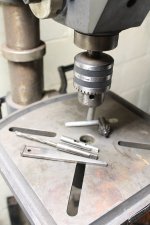
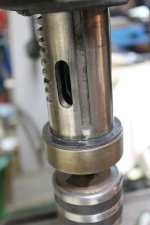
Here a pair of pictures to go along with what I am talking about... My old beater of a drill press (a Sears from the 1980's) Pardon the mess.

On the table of the press is the wedge shaped tool for removing the morse taper chuck & arbor from the quill of the drill press. Also on the table is a really old school Cleaveland drill bit that has a morse taper shank on it, and a MT to MT collet for adapting one size morse taper to another size.

The other photo shows the quill all the way extended. The oval slot in the quill is where you drive in the wedge to remove the drill chuck from the press to change it.

Stamped into the side of the drill chuck is "0.8-16mm JT3"... that reads that this chuck can hold drill bits with a minimum shank diameter of 0.8mm to a maximum diameter of 16mm and the chuck is attached to the arbor with a #3 Jacobs Taper.

This may look like a crazy way of doing this, but the system is very old and works. It's a drill press and it was designed to make holes... all of the forces are acting in the vertical direction and compress those tapered surfaces together. It actually gets tighter as it is being used.

That's why you can have potential problems using one of these in a milling operation. The forces are no longer forcing the tapers together, they are pulling the tapered surfaces apart. And yes, I'll admit it... I've launched a chuck into low earth orbit once or twice by using a drill press to do something other than drill a hole.

Now, having given you the reasons for why doing milling on a drill press carries a bit of risk... I will also say that people, myself included, have done it and gotten away with it. Materials like plastic and wood are easy to cut. So, if you are careful and don't try to cut too fast, you'll probably get away with it as well.
 

Attachments

  • Drill_Press_2.JPG
    Drill_Press_2.JPG
    1.3 MB · Views: 102
  • Drill_Press_1.JPG
    Drill_Press_1.JPG
    1.4 MB · Views: 99
Last edited:
Upvote 0
Thanks to OP for starting this helpful conversation. Tacking on a related question...
Is it recommended to use cutting oil when milling a P80 AR lower? If yes, best options?

 
Last edited:
Upvote 0
Thanks to OP for starting this helpful conversation. Tacking on a related question...
Is it recommended to use cutting oil when milling a P80 AR lower? If yes, best options?
For polymer/plastic milling on P80's product line, use mineral oil available at the grocery store. Cheap: $2-$3 for a bottle and goes a long way. Works on P80 pistols too with drilling, grinding, sanding, etc....
 
Upvote 0
Back
Top