
Be careful about installing solar panels on your home.

Racer88

Big Kahuna Admin
Staff member
Exchange Privileges
Joined
Feb 26, 2022
Messages
21,911
Reaction score
24,903
Points
168
Location
USA! USA!
This is not the first time I've read about this, including actual news articles. Do your homework, folks!
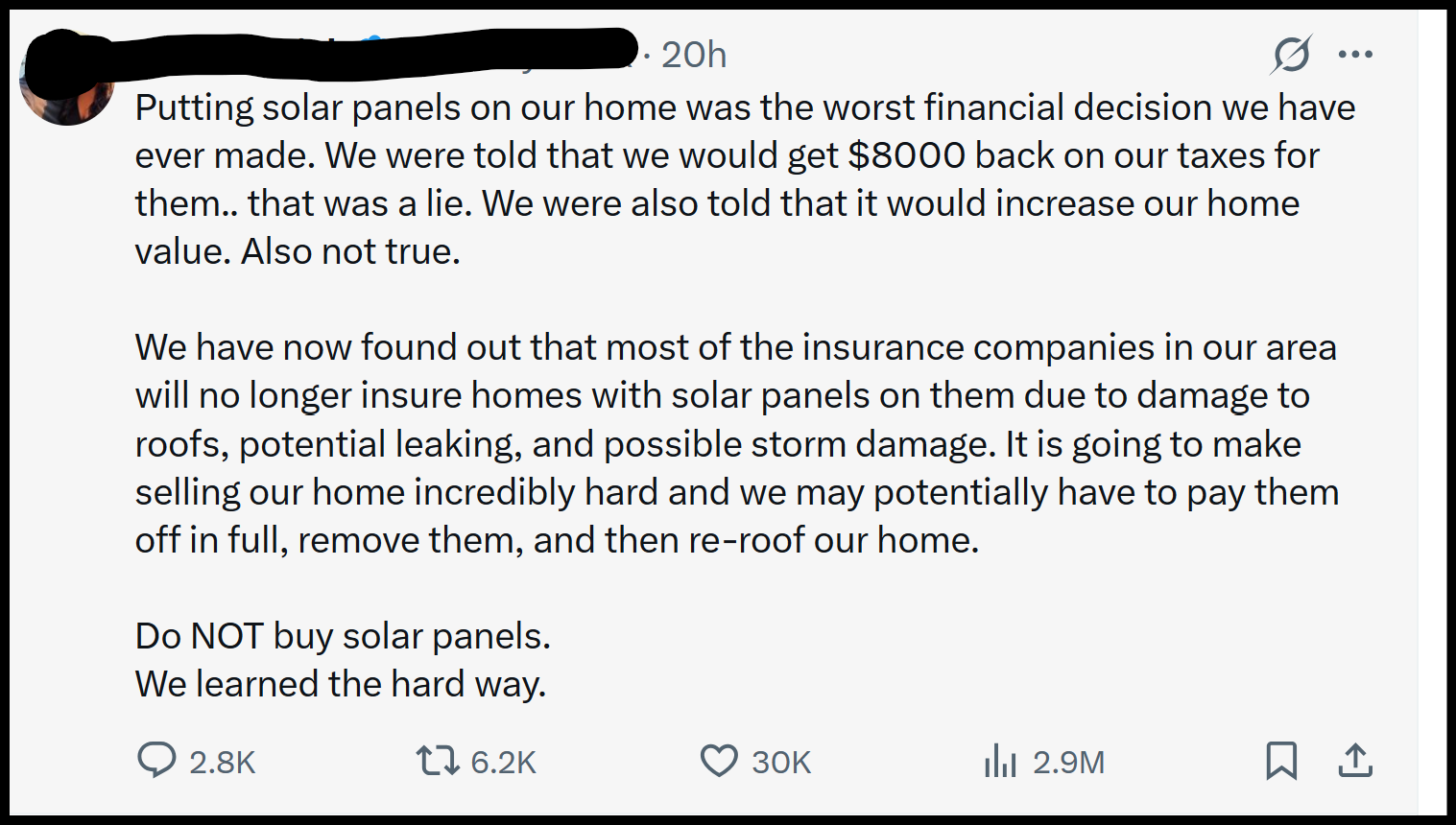
1756653532480.png


If you put solar panels on your roof, your home insurance company could drop you. Fewer insurance companies will even cover solar panels on homes in Florida. It’s happening more and more now. So what’s going on?
"Something is going on, it’s very strange, I can’t underscore how strange it is," Heaven Campbell with Solar United Neighbors said.
Lately, when Floridians want to put solar panels on their home, some home insurance companies are saying goodbye and canceling the policies.


Last edited:
In the same X thread:

1756655505324.png
 
The only roof anyone should put solar panels on are standing seam metal roofs as you don’t have to drill through the roof and the clips attach to the seams. I looked at doing solar years ago but it did not make financial sense for me. The expense of the panels would take 20 years to break even. Take that same money and invest it. In 20 years, you may double or triple the investment and I did just that.

Solar is a feel good product. The markup from China to the US is tremendous and with the new tariffs it makes even less sense. Besides, when you have to change shingles, it adds $5k to $10k to the cost and if you don’t have a standing seam metal roof you are puncturing the water proof membrane to mount the panels. Then there is the warranty issue. You know how many solar installers have gone under over the last few years alone? Also, doubt those made in China panels will be warranted by the manufacturers who probably won’t be in business in 5 years let alone after 20. Then there is the fact they are woefully inefficient to start and then go down as they age.
 
People are stupid and believe what some sales wonk tells them. The solar panel tax credit, also known as the Residential Clean Energy Credit, allows homeowners to deduct 30% of the cost of installing solar panels from their federal taxes. It takes 3 seconds to look this up.

It is also true that some insurers don't like rooftop solar panels. Nothing secret about this either. People don't do their homework.

40% of the electric power feeding my home comes from solar panels. None of the panels are on the roof. That had nothing to do with insurance though. I maintain the system myself and I don't want to be climbing up 35 foot ladders and rambling around on a steep roof to do maintenance or repairs if and when needed.

The wise homeowner puts solar shingles on the roof. Not panels. Or if you have the land, mount them on the ground like I did. When an insurer asks if you have sold panels, the answer is no. The shingles that have cells in them are indistinguishable from the others. Expensive? Yes. They also dont share the wind risk that panels do in hurricane or tornado-prone areas.
 
Last edited:
Another comment from the thread:

Solar panels degrade 0.5–1% per year. By year 20, you’ve lost 20–30% of your output. The break-even point (the mythical “you’ll save money after 8–10 years!”) only works if electricity prices soar, you never need a roof repair, and your inverter doesn’t crap out

Also if you have a Blackout ? Your panels shut off unless you have batteries. And batteries cost another $10K–$20K, degrade faster than the panels, and create their own disposal mess.

You’re still hooked to the grid, and utilities are rewriting net metering rules so they don’t have to pay you fairly for excess power. You’re not escaping the system you’re just buying into a second one with its own costs.

Panels are bolted directly into your roof. If installers cut corners or your roof isn’t new, you’re risking leaks and structural headaches later. And if you need a roof replacement, the panels have to come off at your expense—before work can even begin.

In hail-heavy regions (like Texas), panels are basically glass targets. Sure, they’re “rated” for hail, but insurance companies are notorious for denying solar damage claims or jacking up your premiums. That cost isn’t in the sales brochure.

Also if you’re Selling your home. Try selling a house with a leased solar system. Buyers often see it as a liability. You either eat the lease payoff yourself or risk losing buyers who don’t want the headache of inheriting your contract. Solar doesn’t “add value” it adds complications.

And the inverter (the brain of the system) typically fails after 10–12 years. That’s another multi-thousand-dollar replacement, often not fully covered under warranties. Installers love to ignore this detail when calculating your “break-even point.”——Your panels might generate 11,000 kWh/year, but you don’t use all of that when it’s generated.Solar power hits hardest from 10 a.m. to 3 p.m. Most households use the most energy in the evening, when your panels are doing nothing.

So what happens to your excess solar power during the day? It gets sent back to the grid, and your utility pays you a tiny fraction for it—if anything.

You buy power at $0.14/kWh, but your utility only pays $0.04–$0.06/kWh for your exports.You’re producing “value,” but most of it’s being sold back at a huge discount. That’s like growing fruit and only being paid pennies for the surplus.

Solar sales reps love to say “electricity costs will keep rising!” so your solar savings grow every year.

Truth: Rates might rise, but you have no control over buyback changes, rate design changes, or grid fees that can kill your savings.

California gutted their net metering in 2023—overnight, people lost 70% of their projected savings. This isn’t theory. It’s happening.
 
None of the panels are on the roof.
Or if you have the land, mount them on the ground like I did.

Yeah... most people don't live on land like that. They don't have that option.

The shingles that have cells in them are indistinguishable from the others. Expensive? Yes. They also dont share the wind risk that panels do in hurricane or tornado-prone areas.

LOL! You sure about that? I live in hurricane territory. I cannot imagine solar shingles are more "storm-proof" than regular shingles. If a big one comes through, it won't matter which kind of shingle you have. "Gone with the wind!"

Of course solar panels are effectively just sails or wings on a roof. Just based on Physics, that will likely cause more roof damage than if you didn't have the panels.
 
Another comment from the thread:
Wow. Is the writer saying things wear out after 20 years? Who knew? This guy is a genius!

So does your $60-80,000 car. Long before 20 years passes.
Your 30 year shingles that cost 15-30 grand to replace. Your insurance may drop you if you roof is 15+ years old.
HVAC - 10 grand. Might be 20. depends on what system you have and how big. They last 10 years. You may get 15.
How about carpeting. It's shot in ten years. 10-20k for an average size house
Windows... approximately 30 years. Another ten grand. Maybe more.
The list goes on.

Assuming an easy monthly budget plan for electric power - where you pay the same every month all year. Let's be conservative... a non-solar electric bill of 200 a month for 20 years. $48,000. Big house... way more.

My solar system, which I installed myself, cost 25 grand. I also have two other independent batteries with inverters in outbuilding each with their own panels on the roof. One is a shed, one is a pool cabana. Each of those system cost me about 2 grand (each). They are both completely independent and have no power from the so-called grid. The pool cabana has a small portable AC, a fan, a flatscreen and several 120 VAC outlets for whatever. Works fine. I sit in there all the time in the summer.

None of it has failed in almost five years. Zero maintenance. Zero repairs. Prior to installing any of it my electric bill in the summertime averaged $325/month. Now it's 200. That's a long return on investment but on the other hand I can run my lights and well pump, which means I can read a magazine while taking a dump at 10 pm and flush the toilet when the power goes out. Which happens several times a year.

I have a new, bigger battery that can run the whole house but have to add the add'l panels needed to keep it charged.

I am totally content with solar and it does exactly what I intended. NOTE: I also have a propane whole house generator as a backup. 500 gallon tank. I can cook with the propane as well.
 
Last edited:
Yeah... most people don't live on land like that. They don't have that option.


LOL! You sure about that? I live in hurricane territory. I cannot imagine solar shingles are more "storm-proof" than regular shingles. If a big one comes through, it won't matter which kind of shingle you have. "Gone with the wind!"

Of course solar panels are effectively just sails or wings on a roof. Just based on Physics, that will likely cause more roof damage than if you didn't have the panels.
You'll just have to start imagining :)

The shingles are rigid. Not like asphalt. They stand a much better chance of surviving wind than conventional roofing. They can even handle hail. As long as it's not the size of baseballs.

Even regular panels... there's a lot of horseshit on the web about this. Actual case studies differ. It's important to remember that cat 5 wind that can rip full sized trees out of the ground is going to destroy just about everything, so singling out solar panels is rather ridiculous. When you have a 15-20 foot storm surge, and 150 mph wind, you are fucked. A stop sign flying thru the air at 150 mph can cut you in half. Certainly damage a structure. Thankfully not many storms are cat 5.

The greatest damage to solar panels from wind comes from improper or inadequate mounting. The panels themselves are pretty strong and resilient. Impact is a different issue. If a tree lands on them, they break. In a cat 5 hurricane or tornado, solar panels are going to be the least of your concerns. Bottom line: How they are installed matters.

If those people who are upset weren't smart enough to do their homework, they probably went with low bid and some dude named Booger installed the panels.

I've had some bad storms and was on the outer bands of Helene. Panels were fine. They are on an aluminum frame that's got six uprights, each anchored to concrete pilings four feet deep. It ain't goin' nowhere.
 
I wonder what the roofer's opinion of Barolo Riserva Montrofino '97 is. Surely he's an expert on wine too.

If this is even real. I'd treat this statement with suspicion.

Most residential solar systems are leased and the owner does not do repairs. This is just about all of them. I suppose some put the system in themselves. Preppers living on a homestead maybe. In a residential neighborhood? No way. The homeowners would have to get several permits and submit drawings.

 
I wonder what the roofer's opinion of Barolo Riserva Montrofino '97 is. Surely he's an expert on wine too.

If this is even real. I'd treat this statement with suspicion.

Most residential solar systems are leased and the owner does not do repairs. This is just about all of them. I suppose some put the system in themselves. Preppers living on a homestead maybe. In a residential neighborhood? No way. The homeowners would have to get several permits and submit drawings.


If you can't get homeowners insurance because of solar panels on the roof, it's all moot.
Game over. And that's actually happening.

Personally, I don't have the least bit interest in installing solar panels. But if anyone does, they better do their due diligence before hand.
 
Allstate, Progressive, Nationwide all cover solar panels. But it may increase the premium. I couldn’t find any underwriter that refuses to insure a solar home.

Florida might be unique. Some insurance companies have pulled out of certain areas in FL. Coastal NC as well. They won’t insure you at all. Solar panels or not.
 
I couldn’t find any underwriter that refuses to insure a solar home.
Maybe not where you live. Yet.

Florida might be unique. Some insurance companies have pulled out of certain areas in FL. Coastal NC as well. They won’t insure you at all. Solar panels or not.
Yes. That's true (that some companies have pulled out of the state completely).

But did you not see the news story links I provided above? I quit after citing just three of them. But my search yielded dozens more.

Lately, when Floridians want to put solar panels on their home, some home insurance companies are saying goodbye and canceling the policies.

"Sometimes the homeowners only have 30 days to find replacements," Rebecca Houpe of Ancient City Insurance said.

She's seeing this over and over again in the last year or so.

In addition, some insurance companies that have covered solar panels in the past, are no longer writing new policies.

Home insurance companies are also denying coverage if the homeowner chooses to sell the extra power their panels make back to the electric company. The system is called net metering, and it's a common practice for a homeowner with solar panels.

Campbell said the fact that insurance companies are denying coverage because of net-metering "which is a billing methodology" is odd.

Insurance companies are canceling policies based SOLELY on the presence of solar panels on the roof. It's a fact. And it makes sense.... having big wings or sails on your roof in 120-mph++ winds is not going to end well.
 
Last edited:
Funny this thread should pop up but there was a salesman knocked on the door just this evening trying to schlep them with all the promises of "free money" mentioned above. :rolleyes: The wife sent him on his way "No thanks, insurance is hard enough to get here as it is!"

I am not against solar at all, especially here in FL. BUT:
  • I'm not about to let some schlub go driving screws into our less than 5yo roof.
  • The front of our house faces south and they could look unsightly and also retain/amplify heat.
  • Our neighbor has them and although they like the energy savings, the install was less than satisfactory and took several months to complete. They had a couple pallets of panels in their driveway for 2 months before work even began. :rolleyes:
  • A couple years ago, Allstate dropped us after 20ish years. No particular reason except for they are getting out of the high-risk FL market. The only claim we had was a $10,000ish claim with them after the 2004 hurricanes--tree put a hole in the roof and another landed on our shed. We were lucky to get another ins. company but that required all sorts of inspections and whatnot. And I couldn't tell you their name but some new guy on the block. Gods forbid we have to file a claim... :(
Last year, I almost had a contract to remove a mezzanine from a building. Like 20'x30' or so. Somebody actually paid them good money to remove it so that deal fell through. :( But that structure would have become the support structure for mounting in the yard probably like what @Bongo Lewi has (BL, do you have a pic of yours?) My two concerns would be the length of cable I need would be close to 200' and glare/reflections from the panels at certain times of the day/season because they would be north of the house in the backyard.
 
Insurance companies bailing out of certain markets is a much bigger problem. I get that insurance is a business of calculated risk, but you cant get a mortgage without insurance and even if you have the means to buy the house without a loan, it's crazy to not insure it.

The insurance regulators/comissioners at the state level are too cozy with the insurance companies. I have seen this in every state I've lived in. I have written reps and senators that there should be a law that mandates if you want to do business in NC, you have to serve the whole state. Rates... I'm fine with them being higher in high risk areas. Not being able to get insurance at all is not OK.
 
Funny this thread should pop up but there was a salesman knocked on the door just this evening trying to schlep them with all the promises of "free money" mentioned above. :rolleyes: The wife sent him on his way "No thanks, insurance is hard enough to get here as it is!"

I am not against solar at all, especially here in FL. BUT:
  • I'm not about to let some schlub go driving screws into our less than 5yo roof.
  • The front of our house faces south and they could look unsightly and also retain/amplify heat.
  • Our neighbor has them and although they like the energy savings, the install was less than satisfactory and took several months to complete. They had a couple pallets of panels in their driveway for 2 months before work even began. :rolleyes:
  • A couple years ago, Allstate dropped us after 20ish years. No particular reason except for they are getting out of the high-risk FL market. The only claim we had was a $10,000ish claim with them after the 2004 hurricanes--tree put a hole in the roof and another landed on our shed. We were lucky to get another ins. company but that required all sorts of inspections and whatnot. And I couldn't tell you their name but some new guy on the block. Gods forbid we have to file a claim... :(
Last year, I almost had a contract to remove a mezzanine from a building. Like 20'x30' or so. Somebody actually paid them good money to remove it so that deal fell through. :( But that structure would have become the support structure for mounting in the yard probably like what @Bongo Lewi has (BL, do you have a pic of yours?) My two concerns would be the length of cable I need would be close to 200' and glare/reflections from the panels at certain times of the day/season because they would be north of the house in the backyard.
I am not home right now but will post a pic when I return
 
Last edited:
FPL is going to end up in court for putting a clause in their contracts that if your solar system somehow fails and damages the 'grid' or neighboring homes on the same transformer, you are liable. This has a lot to do with why insurance companies are not insuring Florida homes with solar panels. It's also bullshit. There isn't a single case of solar panels causing that sort of damage.

I haven't found a single insurer in NC who wont cover solar panels. Progressive, State Farm, Allstate, Liberty, USAA. All good.

Like I said... most residential solar power systems are sold as a package. It's a lease, actually. You dont insure it. They do. These companies make their profit by selling your surplus power back to the local utility. They own the system. There are a lot of clowns getting into that business - so caveat emptor.

There is one gotcha with these leased deals. A friend of mine in MD signed on to one of those solar lease deals. The contract was for 10 years. His power bill was almost zero (some unescapable MD taxes and meter/billing fees). Of course he had to pay the lease every month but it was way less than his former power bill. Less than half. Problem was... everything was peachy until three years later he gets a big job offer in Arizona. They had to sell the house. Getting a buyer to assume the lease was complicated. He decided to pay off the lease and move on. The solar company removed all the equipment.
 
Funny this thread should pop up but there was a salesman knocked on the door just this evening trying to schlep them with all the promises of "free money" mentioned above. :rolleyes: The wife sent him on his way "No thanks, insurance is hard enough to get here as it is!"

I am not against solar at all, especially here in FL. BUT:
  • I'm not about to let some schlub go driving screws into our less than 5yo roof.
  • The front of our house faces south and they could look unsightly and also retain/amplify heat.
  • Our neighbor has them and although they like the energy savings, the install was less than satisfactory and took several months to complete. They had a couple pallets of panels in their driveway for 2 months before work even began. :rolleyes:
  • A couple years ago, Allstate dropped us after 20ish years. No particular reason except for they are getting out of the high-risk FL market. The only claim we had was a $10,000ish claim with them after the 2004 hurricanes--tree put a hole in the roof and another landed on our shed. We were lucky to get another ins. company but that required all sorts of inspections and whatnot. And I couldn't tell you their name but some new guy on the block. Gods forbid we have to file a claim... :(
Last year, I almost had a contract to remove a mezzanine from a building. Like 20'x30' or so. Somebody actually paid them good money to remove it so that deal fell through. :( But that structure would have become the support structure for mounting in the yard probably like what @Bongo Lewi has (BL, do you have a pic of yours?) My two concerns would be the length of cable I need would be close to 200' and glare/reflections from the panels at certain times of the day/season because they would be north of the house in the backyard.

Aluminum framed solar panels like I have are fine, but these are the next generation residential product. It's not a wing or dial on the roof. They nail down just like shingles. They are rigid and dont lift with high wind like asphalt shingles. In a bad storm you are most likely to lose the asphalt ones, not these solar shingles.

The best time financially is to add these is when you are putting on a new roof. Or new construction.

100% of your residential power needs can now be done affordably with solar without unsightly roof panels. My question is... insurance issued in Florida aside, why would anyone not do it? Especially if you are renovating or building a new home.

I dont get why there's so much friction in adopting solar. For residential it's a fucking no brainer. Other than those who believe that five to ten years from now you will be dead and don't want to spend the money. That I understand. A lot of the more radical gun owners truly believe a SHTF event is possible and talk about being ready. Both natural or human-caused. No power, no water, no fuel. Food, water, energy is not optional. If you are independently electric, you can make your own fuel. Making your own gasoline, quite a bit harder.
 
Last edited:
Insurance companies bailing out of certain markets is a much bigger problem. I get that insurance is a business of calculated risk, but you cant get a mortgage without insurance and even if you have the means to buy the house without a loan, it's crazy to not insure it.

The insurance regulators/comissioners at the state level are too cozy with the insurance companies. I have seen this in every state I've lived in. I have written reps and senators that there should be a law that mandates if you want to do business in NC, you have to serve the whole state. Rates... I'm fine with them being higher in high risk areas. Not being able to get insurance at all is not OK.

Well, look at which industry is #3 in the top 20 of lobby money spent:

1756739732607.png
 
I haven't found a single insurer in NC who wont cover solar panels. Progressive, State Farm, Allstate, Liberty, USAA. All good.

Like I said... most residential solar power systems are sold as a package. It's a lease, actually. You dont insure it. They do.

Ah, but it's not about insuring the PANELS. The inscos won't insure your HOUSE if you HAVE panels on the roof. It's the HOUSE, not the panels. Put panels on your house, and the insco will DROP your HOME OWNERS coverage.

And while I'm not a fan of inscos, I can't blame them for canceling policies for home where the owner has jeopardized the integrity of the house structure such that they are at MUCH higher risk for damage / loss in a storm. Gee.... who woulda thunk that bolting a SAIL to your roof would be a problem during hurricanes? That's not to mention drilling HOLES through the roof.

And yes... if you have any knowledge of Physics and aerodynamics... this is a HUGE problem during a hurricane. It is a sail that will either be ripped FROM the roof (leaving big holes).... or ripped WITH the roof... and will go "hasta-la-bye-bye" in a hurricane.

1756740268983.jpeg


1756740153982.jpeg
 
Last edited:
Back
Top