

You are using an out of date browser. It may not display this or other websites correctly.
You should upgrade or use an alternative browser.
You should upgrade or use an alternative browser.
"Official" Thread Assorted Funny $hit
- Thread starter no4mk1t
- Start date


Hey, I know a dude that can beat this setup...

From what has been in the news lately of idiots who have tried this, they lasted a matter of days before the people they protest in favor of killed them.


This pic reminds me of a funny story.
In another life many years ago, I was an Evinrude Master Technician.
The dealership I worked for sold a Stern Drive boat to a rich guy that was building what was at the time the largest gated community in the county on the lake. As with many guys like him, he was arrogant and knew better than some lowly plebes at a boat dealership.
He bought the boat in May and used it that summer without incident.
All customers that bought a boat were mailed a postcard in October reminding them to bring their boat in to be winterized.
Mr. Arrogant did not bring his boat in to be winterized. For those that know, these boats draw in lake water to cool the engine and exhaust manifolds. this water must be drained before the first freeze to avoid very expensive consequences. And that is exactly what happened.
Come Spring, he takes the boat out to the lake and discovers that both the block and both manifolds have split wide open. He brings it in. Of course this is not under warranty.
Long story shorter, with some of the parts on B/O, it's August before he gets the boat back. That year there was a drought and all the lakes were very low. He has the boat back about two weeks and has the misfortune to hit a stump due to the low water levels. Tears the outdrive off the stern. It comes back to the shop hanging by the control cables. By now, we start to wonder if the boat is jinxed.
Now he has learned the lesson that a boat is a hole in the water into which you put money.
The repairs take a couple of months and by then the boating season is over.
Mr. Arrogant decides he no longer wants to be a boat owner and sells the boat to his #1 salesman.
But the story doesn't end there.
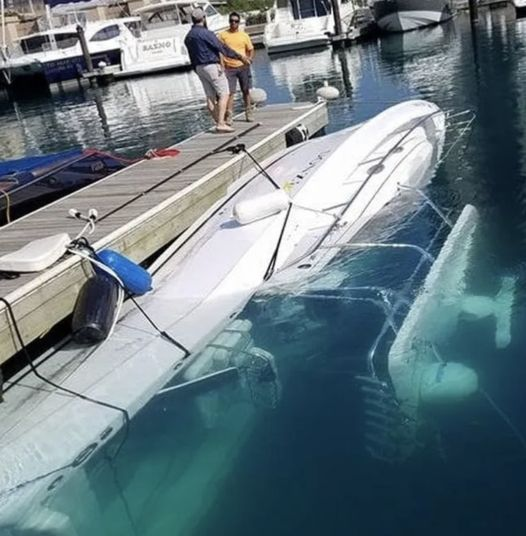
Mr. Salesman decides to moor the boat at the gated communities private marina. It was tied to the dock much like the boat pictured below.
Now OMC Stern Drives differed from Mercruiser in that the engine and drive unit were bolted together as a single unit. To control pitch trim, the engine and drive unit were mounted in a trunnion at the rear of the engine and at the front was a jack screw with an electric motor to raise and lower the unit. Where the unit passed through the transom, there was a bellows seal to allow movement, but kept the water out. For some reason, the beavers loved to chew on this bellows seal. Almost like they added the beaver version of catnip in the rubber. There was a "rodent guard" available as an accessory, but it was up to the owner to have it installed. Neither Mr. Arrogant or Mr. Salesman had it installed.
We get a service call one morning from Mr. Salesman. Help, help! My boat is sinking.
We go out to the marina and sure nuff, his boat is swamped up to the gunnels. Only the ropes tying to the dock kept it from sinking.
We examine the stern and see the quarter size hole chewed in the bellows seal. The Service Manager takes a shop rag and pokes it in the hole. Goes up to the dash and uses his boot to activate the bilge pump. Mr. Salesman says "Now what?". Service Manager says, "Hope you have a good battery." We stand around as the boat slowly rises from the lake.
When you sink a boat like this, you pretty much need to replace all the electrical items. You can try and dry them out, but within a month or two, they fail. When Mr. Salesman got the boat back, he also decided he no longer wanted to be a boat owner. After that, whoever he sold it to took it away from the area. We never learned if the jinx transferred to the new owner.
So, Stern Drives or I/O as they are know were designed back in a time when outboards were small and under powered. By utilizing 6 and 8 cylinder auto engines, more power was available for larger boats. This gap closed by the 70's when outboards of 135+ H.P. became available. And by the 80's, V-6 outboards of 200+ H.P. were common. Outboards are far less maintenance intensive than I/O's.
So, the morale of the story is, beaver proof your Stern Drive and make sure to winterize.
In another life many years ago, I was an Evinrude Master Technician.
The dealership I worked for sold a Stern Drive boat to a rich guy that was building what was at the time the largest gated community in the county on the lake. As with many guys like him, he was arrogant and knew better than some lowly plebes at a boat dealership.
He bought the boat in May and used it that summer without incident.
All customers that bought a boat were mailed a postcard in October reminding them to bring their boat in to be winterized.
Mr. Arrogant did not bring his boat in to be winterized. For those that know, these boats draw in lake water to cool the engine and exhaust manifolds. this water must be drained before the first freeze to avoid very expensive consequences. And that is exactly what happened.
Come Spring, he takes the boat out to the lake and discovers that both the block and both manifolds have split wide open. He brings it in. Of course this is not under warranty.
Long story shorter, with some of the parts on B/O, it's August before he gets the boat back. That year there was a drought and all the lakes were very low. He has the boat back about two weeks and has the misfortune to hit a stump due to the low water levels. Tears the outdrive off the stern. It comes back to the shop hanging by the control cables. By now, we start to wonder if the boat is jinxed.
Now he has learned the lesson that a boat is a hole in the water into which you put money.
The repairs take a couple of months and by then the boating season is over.
Mr. Arrogant decides he no longer wants to be a boat owner and sells the boat to his #1 salesman.
But the story doesn't end there.
Mr. Salesman decides to moor the boat at the gated communities private marina. It was tied to the dock much like the boat pictured below.
Now OMC Stern Drives differed from Mercruiser in that the engine and drive unit were bolted together as a single unit. To control pitch trim, the engine and drive unit were mounted in a trunnion at the rear of the engine and at the front was a jack screw with an electric motor to raise and lower the unit. Where the unit passed through the transom, there was a bellows seal to allow movement, but kept the water out. For some reason, the beavers loved to chew on this bellows seal. Almost like they added the beaver version of catnip in the rubber. There was a "rodent guard" available as an accessory, but it was up to the owner to have it installed. Neither Mr. Arrogant or Mr. Salesman had it installed.
We get a service call one morning from Mr. Salesman. Help, help! My boat is sinking.
We go out to the marina and sure nuff, his boat is swamped up to the gunnels. Only the ropes tying to the dock kept it from sinking.
We examine the stern and see the quarter size hole chewed in the bellows seal. The Service Manager takes a shop rag and pokes it in the hole. Goes up to the dash and uses his boot to activate the bilge pump. Mr. Salesman says "Now what?". Service Manager says, "Hope you have a good battery." We stand around as the boat slowly rises from the lake.
When you sink a boat like this, you pretty much need to replace all the electrical items. You can try and dry them out, but within a month or two, they fail. When Mr. Salesman got the boat back, he also decided he no longer wanted to be a boat owner. After that, whoever he sold it to took it away from the area. We never learned if the jinx transferred to the new owner.
So, Stern Drives or I/O as they are know were designed back in a time when outboards were small and under powered. By utilizing 6 and 8 cylinder auto engines, more power was available for larger boats. This gap closed by the 70's when outboards of 135+ H.P. became available. And by the 80's, V-6 outboards of 200+ H.P. were common. Outboards are far less maintenance intensive than I/O's.
So, the morale of the story is, beaver proof your Stern Drive and make sure to winterize.
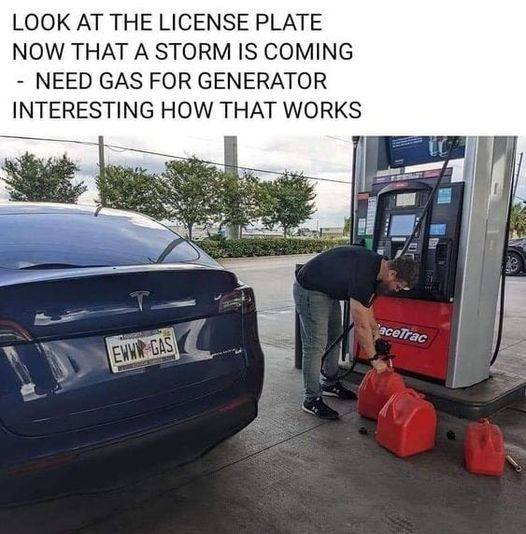
When you're a part-time "green weinie".
Now if he was "all-in" with his greenness, he would have spent the money to be able to power the house off the Tesla's batteries when the grid goes down.
Now if he was "all-in" with his greenness, he would have spent the money to be able to power the house off the Tesla's batteries when the grid goes down.